The Listening Room
A soft room for voices, detail, and concentrated review.
Choose it when the project depends on tone, silence, or the tiny decisions that disappear through ordinary speakers.
Rooms for changing attention
Find your room
The Listening Room
Choose it when the project depends on tone, silence, or the tiny decisions that disappear through ordinary speakers.
The spaces at Media Retreats are organized by the kind of attention they support rather than by prestige or hierarchy. A compact writing room can be as important as the screening studio. A sheltered outdoor bench may unlock a problem that resisted every tool indoors. Each environment has a clear purpose, but none is so rigid that guests cannot adapt it. The aim is to offer recognizable modes of work and make moving between them easy.
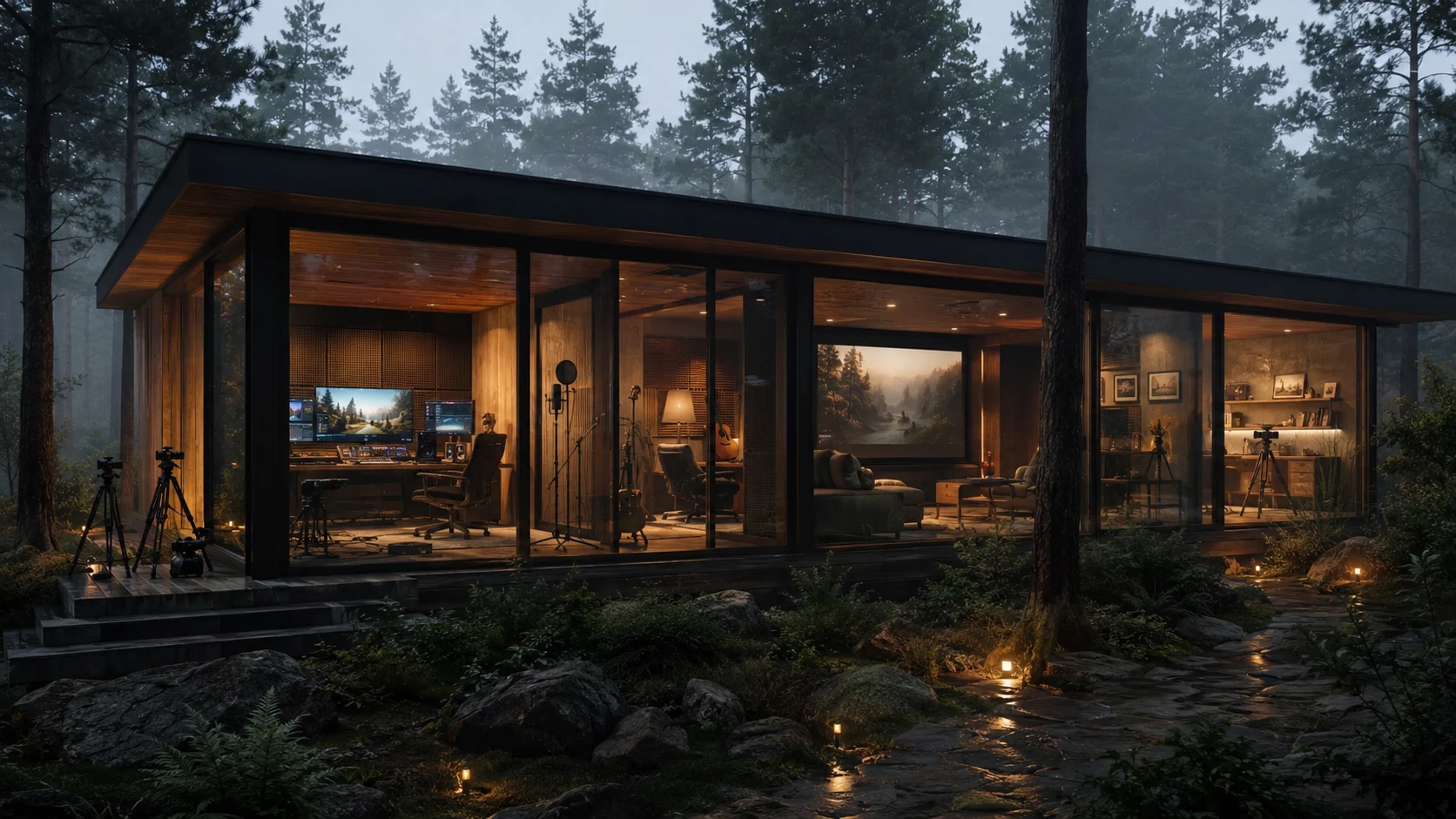
The Listening Room is built for podcasts, interviews, voice work, and careful sound review. Soft surfaces reduce distraction without making the room feel sealed away from the landscape. Microphones and monitoring equipment are ready to use, while the furniture supports both formal recording and relaxed conversation. A guest can capture a polished episode in the morning, then return later to listen from the audience’s perspective rather than the producer’s chair.
The Edit Cabin supports concentrated picture and sound work. Its displays are calibrated, storage connections are simple, and the lighting can shift from daylight to a controlled review setting. The room is deliberately compact. Large enough for a small team, it avoids the restless feeling of an oversized post-production facility. Nearby is the Projection Loft, where rough cuts, photographic sequences, title ideas, and presentation rehearsals can be viewed at a larger scale. This helps artists notice rhythm and proportion that disappear on a laptop.
The Long Table is the social heart of the retreat. It hosts meals, story mapping, contact sheets, planning sessions, and occasional arguments that become better ideas. Supplies are close at hand, but the table is never permanently claimed by one discipline. Writers work beside designers; producers compare notes with photographers; sound artists sketch structures that look like maps. Cross-pollination happens naturally because people see how others frame problems.
Beyond these named rooms are smaller transitional places: a covered porch for reading, a path with marked stopping points, a library corner, a dark room for resting the eyes, and a sheltered platform facing the water. They are not decorative extras. Creative attention changes throughout a day, and a useful retreat gives that change somewhere to go. Guests can choose a space according to the task, their energy, and the amount of company they need. The selector on this page offers a playful starting point, but the real method is simple: notice what the work asks for, then enter the room that makes that kind of attention easier.